

Pentax K20D and K200D Preview and comparison
Pentax have released details on two new DSLRs, the K20D and K200D.
The Pentax K20D
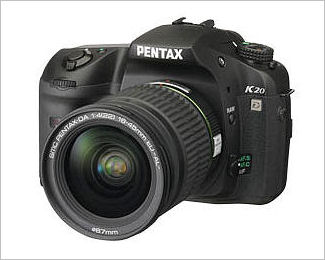
The Pentax K20D features a 14.6MP APS-C sized CMOS sensor, the highest pixel count found on any consumer DSLR to date, and a number beaten only by the vastly more expensive Canon EOS 1Ds MkII and MkIII. Pentax claim that the pixels are no smaller than those found on most 12MP DSLRs because they have less space between them "...After a thorough review of previous image sensors, PENTAX greatly reduced the area of circuitry around the pixel field to expand the light-sensitive area...". Small pixels typically result in higher noise, so if Pentax have a 14.6MP sensor with the same noise as other 12MP sensors, it should be a very interesting camera! Another notable feature is an ISO range from 100 to 6400, and the provision of a 6400 setting suggests that Pentax probably have managed to keep the noise down.
Also unusual for a camera in this price class (<$1300) is the fact that the Pentax K20D is weather sealed, with gaskets on all the buttons, switches and levers to keep dust and water out of the camera. If that's not enough, the K20D also features image stabilization built into the camera body which Pentax claim is good for up to 4 stops of added stability! As is now common, the sensor has a built in "shake" system to minimize dust. One area in which the K20D trails the competition a little is the maximum continuous shooting speed of 3fps (the EOS 40D is 6.5fps), though the K20D does offer a frame rate of 21fps in a reduced size (1.6MP) mode. That's almost video speed, though it's limited to 115 frames.
The Pentax K20D also has a dynamic range expansion mode, which Pentax claim can yield an extra 1EV of dynamic range. Presumably this is similar to the "Highlight Tone Priority" which is now found on new Canon EOS bodies. Few other features include:
- Choice of 16-segment multi-pattern metering, center-weighted metering and spot metering to accommodate various photographic applications
- Reliable, durable shutter unit assuring more than 100,000 shutter releases
- High-rigidity stainless-steel chassis
- 36 custom functions to personalize camera operations
- Universal-type X-sync socket (new feature)
- RAW button for single-action image-file switching
- Digital Preview for recording images in addition to checking
- Optional Battery Grip (D-BG2) for extended shooting sessions
- Nine digital filters to add creative and artistic touches
- In-body RAW data development for image filing in JPEG and TIFF formats
- Compatibility with SDM equipped lenses for quiet, extra-smooth autofocus operation
The Pentax K200D
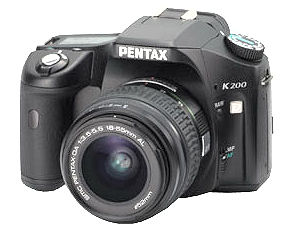 The Pentax K200D is a little more modest, but also significantly cheaper ($699.99 vs. $1299.99). It features a 10.2MP CMOS sensor with an ISO range of 100-1600. It shares the weather sealing, image stabilization and anti-dust features of the K200D. The viewfinder is slightly smaller than that of the K20D and uses a pentamirror in place of a pentaprism. Still, the specification are pretty impressive for a camera which should initially sell for $699.99. Competitors in the same price class would be the Sony A200 , the Canon Rebel Xsi , the Nikon D80 and, if the smaller Four Thirds sensor doesn't bother you, the Olympus E-510. On paper the Pentax K200D looks like the most interesting of all these cameras, but we'll have to wait until one is avialable for testing to see just how well it performs.
Other features include:
- High-rigidity stainless-steel chassis
- Choice of 16-segment multi-pattern metering, center-weighted metering and spot metering to accommodate various photographic applications
- 22 custom functions to personalize camera operations
- Approximately 1100 images can be taken when using AA size lithium batteries due to its energy saving design
- Compatibility with conventional SD and large-capacity SDHC memory cards
- Simultaneous recording of RAW- and JPEG-format images
- RAW button for single-action image-file switching
- Eight digital filters for creative and artistic expressions
- In-body development of recorded RAW-format images
- Compatibility with SDM equipped lenses for quiet, extra-smooth autofocus operation
Some Comments on Body Based IS
The fact that both the Pentax K20D and K200D have image stabilization built into the body gives them a significant advantage over offerings from Canon and Nikon in this price class. Though it may be true (as Canon and Nikon claim) that lens based stabilization is better, it's nevertheless also true that body based stabilization works well (at least for non-extreme telephoto lenses). It also provides stabilization with EVERY lens mounted on the camera at no additional cost. Neither Nikon nor Canon offer any image stabilized wide or normal prime lenses, and their IS/VR lenses have an additional cost due to the IS/VR electronics and optics which must be installed. In my opinion, body based stabilization is more desirable, certainly for consumer and prosumer cameras and I think eventually Nikon and Canon may be forced to follow the trend being set by Pentax, Sony and Olympus and provide at least some camera modes with body-based stabilization. I don't expect it will happen soon, but I hope it will happen.
The table below compares some of the features of the Pentax K20D and K200D. The areas in bright blue show where one camera has an advantage over the other.
Comparison of the Pentax K20D and K200D Specifications

