.jpg)
Extended Cooker Dish - Update #1
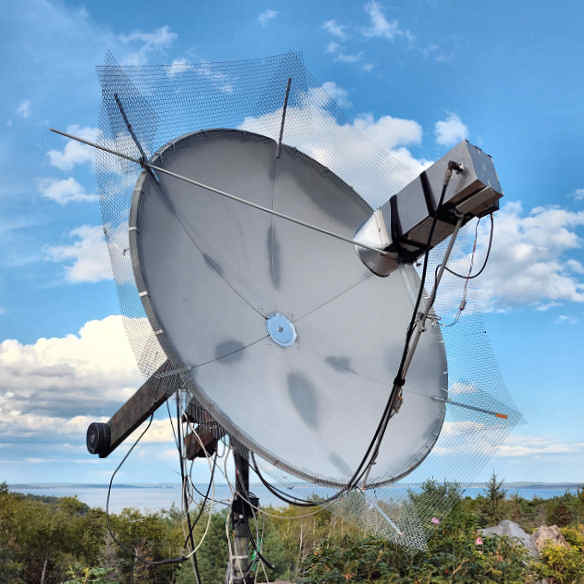
Here are a few more details of tests and measurements on the expanded 1.5m cooker dish. The focal length of the dish seems to be about 22" (~56cm). This does not change with extension of course. While the earlier page shows a hexagonal extension which measured a theoretical 1.732m across the flats, the actual extension on the dish measures closer to 1.8m. It depends on exactly how you position the 12" wide strips. So the extension was ~20mm across the flats in my actual installation. This would produce an f/d of about 0.3125 across the flats. The apex to apex distance is approximately 2.08m, which would yield an f/d of 0.27. If you average this out to get the best equivalent circular approximation, it's something like a 1.9m dish with an f/d of 0.3. A pretty deep dish. The size of the extension comes from the natural fitting of the 12" by 43" mesh panels. They are 12" wide because that's half the width of the roll of mesh I purchased! There are no precision calculated "magic numbers" here!
Here are a few more pictures of the extension:
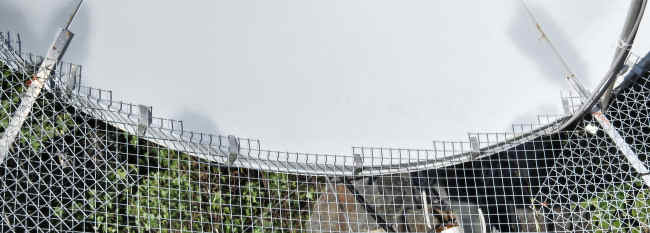
This shows how the mesh is cut away to minimize changing the dish profile at the edge
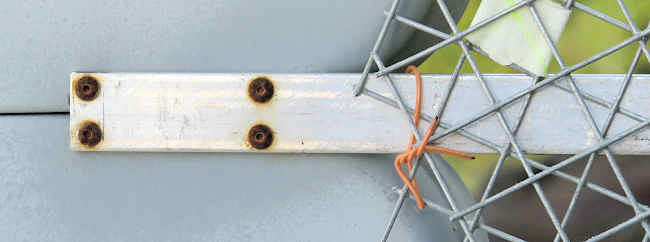
This shows the 2-56 screws holding the extension rib to the dish (which was drilled and tapped 2-56. Stainless steel screws would be better!
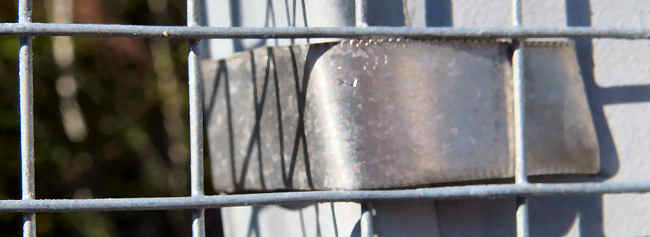
This shows a strip of ~22awg hard aluminum which is bent so that it holds the mesh to the edge of the dish
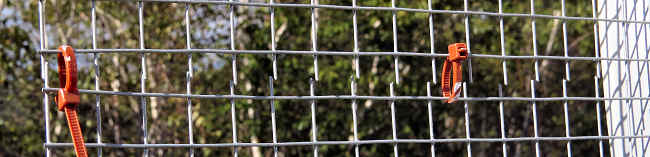
This shows how the mesh sheet can be cut to enable it to better follow a parabolic profile
The extension has proven to be pretty stable. It doesn't flex in the wind (but no hurricanes yet!) and it's small enough to probably stand up to snow quite well. My other dish is a 2.4m circular dish extended out to a 12 sided (duodecagon), which equates to about a 3.1m dish with an average f/d of around 0.35. This dish has a septum feed and flare, but also a choke. Over a range of measurements, from Q65 decoding to sun noise and echo testing, the expanded cooker dish seems to be of the order of 4.5dB down on the 3.1m dish on Rx, which is surprising close to the simple ratio of their areas (about 4.25dB). The expanded cooker dish would have slightly less feedthrough since the center 1.5m is solid. The 3.1m dish also has a feed with a choke, which could easily give it an advantage of 0.5dB or more. These are all simple "first order" effects. Things like phase errors also have an effect.
Performance
What does this mean in terms of performance? Well, I don't have good "before and after" comparison numbers, because this is a new feed with a new flare. What it means now is sun noise at around 10dB when the solar flux at 10.7cm is around 100SFU. I hear echoes from my 3.1M dish with 240W at the feed at around -11.5dB on the extended cooker dish, when the 3.1m dish hears them at closer to -7dB.
Q65 decodes are typically about 3 to 5dB down on the 3.1m dish. From the results of many tests, made over several years, the 3.1m dish is known to hear very well. Here's an example. Moon elevation was around 27 degrees.
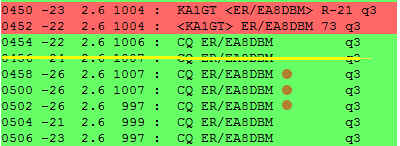
The initial QSO with ER/EA8DBM (portable in Moldova) was made using my 3.1m dish (240W), followed by copying his next CQ with the same dish. SNR was -22dB. Then I switched to the extended cooker dish and his next 3 CQs received in that dish (marked with red dots), which were copied at -26dB. Finally I switched back to the 3.1m dish for the last two CQs, which again average at -22dB. So under these particular conditions, with ER/EA8DBM, the extended cooker was about 4dB down on the larger dish - which is surprisingly good. Remember though that all these SNRs are rounded to the nearest integer value. Different dishes, different feeds, different LNAs and different isolation relays of course - and different pointing accuracy by different controllers on different AZ/El mounts, so how much of the difference is due to the dish and how much is due to all the other factors is unknown. Dish pointing isn't 100% perfect with either system, but both should be pretty good. At 0456 the dish changeover was made during the transmission, so I have not used the -24dB value which was recorded for that transmission.
Here's a summary of the average SNR at which a number of stations decoded CQ calls from HB9Q. This data is from LiveCQ. All these calls were on the same moon pass, so with the same Dgrd. The time span covered was about 7 hours. "N" is the total number of times a given station decoded a CQ from the station calling.
The first list shows how well various stations copied HB9Q's CQ calls:
UA9FAD: 3.60 dB (n=5)  - 3m f/d 0.28
KA1GT: 0.06 dB (n=17) - extended cooker dish, 20cm (~ 8") extension ~ 1.9m
N5TM: -0.17 dB (n=6) - 3.08m
DL6ZG: -1.00 dB (n=4) - 3m
UA1ALD: -1.33 dB (n=6) - 3m
N0LWF: -1.50 dB (n=16) - 2.6m
OK1USW: -3.00 dB (n=2)
DF2VJ: -4.00 dB (n=3) - 2.6m
KC2HFQ: -6.56 dB (n=9) - cooker, 1.5m
N8XS: -8.00 dB (n=3) - cooker (1.5m?)
W3TI: -8.55 dB (n=11) - 2.4m or 1.5m
AC2AC: -10.67 dB (n=3) - 2.4m
ES3RF: -11.40 dB (n=5) - 3m
RA4HL: -24.00 dB (n=1)
This second list is how well various stations copied RA4HL's CQ calls.
OK2DL: -0.40 dB (n=5) - 6m
UA9FAD: -3.96 dB (n=26) - 3m f/d 0.28
UA1ALD: -7.83 dB (n=30) - 3m
KA1GT: -8.17 dB (n=29) - extended cooker dish, 20cm (~ 8") extension ~ 1.9m
N0LWF: -9.68 dB (n=28) - 2.6m
ES3RF: -9.80 dB (n=10) - 3m
DF2VJ: -11.50 dB (n=28) - 2.6m
AC2AC: -15.60 dB (n=5) - 2.4m
KC2HFQ: -15.83 dB (n=6) - cooker, 1.5m
W3TI: -16.06 dB (n=17) - 2.4m or 1.5m
N8XS: -18.50 dB (n=16) - cooker (1.5m?)
On the following moon pass (09/06/2026), looking at 10 hours of live CQ monitoring: First looking at CQs from HG80BAY
OK2DL: -8.30 dB (n=89) - 6m
IK2DDR: -13.09 dB (n=79)- 3.7m
UA9FAD: -13.10 dB (n=78) - 3m
W2ZQ: -14.11 dB (n=37) - 4.6m? 3m?
DL6ZG: -15.22 dB (n=18) - 3m
ES3RF: -15.51 dB (n=85) - 3m
UA1ALD: -15.53 dB (n=58) - 3m
KA1GT: -16.03 dB (n=87) - extended cooker dish, 20cm (~ 8") extension ~ 1.9m
OK1USW: -16.25 dB (n=12) - 3m
DF2VJ: -17.14 dB (n=87) - 2.6m
AC2AC: -19.35 dB (n=26) - 2.4m
LU1HKO: -21.00 dB (n=14) - 3m
W3TI: -23.22 dB (n=9)- 2.4m or 1.5m
And second, looking at CQs from IK2DDR
OK2DL: -3.21 dB (n=47) - 6m
UA9FAD: -9.55 dB (n=49) - 3m
DL6ZG: -10.10 dB (n=30) - 3m
UA1ALD: -10.82 dB (n=28) - 3m
ES3RF: -10.82 dB (n=45) - 3m
KA1GT: -11.09 dB (n=53) - extended cooker dish, 20cm (~ 8") extension ~ 1.9m
N5TM: -11.29 dB (n=7) - 3.08m
N0LWF: -11.58 dB (n=24) - 2.6m
DF2VJ: -13.40 dB (n=53) - 2.6m
AC2AC: -15.44 dB (n=16)- 2.4m
LU1HKO: -17.44 dB (n=50) - 3m
W3TI: -18.09 dB (n=11)- 2.4m or 1.5m
KC2HFQ: -18.82 dB (n=17) - cooker, 1.5m
Caveats: Obviously this list does not tell you everything you need to know about how well any particular dish is working. It doesn't tell you if some of the stations were suffering from partial blockage by trees for example. It doesn't tell you if some decodes were at moonrise or moonset with added ground noise. It doesn't tell you how well calibrated the tracking was. It doesn't tell you if any of the stations was suffering from local noise sources or other QRM, or if they had other Rx issues at the time of measurement. However if you take it just as some sort of overall indication of how well the extended cooker dish might be expected to work under good conditions when receiving a Dx station, I think it tells you something.
Here is a single QSO which I followed using QMAP. This also give comparative station information. KB2SA is using a 1m dish and around 1000W I think. KN2K is using a 1.5m cooker dish and ~ 380W according to the HB9Q database, but Tx power isn't important for this analysis since it's just comparing relative Rx performance.
260906_171400    76.980   76.6   2.62  -17  60C  KN2K KB2SA DM13
260906_171500    76.479   76.1   2.62  -21  60C  KB2SA KN2K -27
260906_171600    76.974   76.6   2.62  -17  60C  KN2K KB2SA DM13
260906_171700    76.473   76.1   2.62  -20  60C  KB2SA KN2K -27
260906_171800    76.971   76.6   2.62  -17  60C  KN2K KB2SA R-27
The sequence goes as follows. At 1714 KB2SA calls KN2K. I hear him at -17dB on the extended cooker dish. At 1715 KN2K replies and copied KB2SA at -27dB. I copied KN2K at -21dB. A call is them missed but at 1717, KN2K calls KB2SA and then KB2SA replies confirming and giving a report of -27dB. I copied the same KN2K transmission at -20dB. All SNR reports are rounded to the nearest dB and that has to be taken into account. This QSO sequence suggests that I head KN2K 7dB stronger than KB2SA heard him. And that I head KB2SA 10dB stronger than KN2K head him. If you throw in +/- 0.5dB uncertainty on each SNR report simply due to rounding to the nearest integer, then There could be as much as a +/- 1dB uncertainly in the difference due to rounding. This doesn't take into account possible differences in libration fading due to 3 different locations being involved, though this is probably a small effect. Note that my decodes are all effectively Q0 unassisted because QMAP does not use AP decoding, but that should not affect their numberical value. One other factor to be considered is how accurately QMAP is when signals at -27dB are involved. However the method of using QMAP for station comparison is illustrated by this sequence. It can, of course, also be done with WSJTX if you are monitoring the correct frequency. For unattended monitoring, QMAP records the whole 23cm band for both 60C and 30B signals.
For example I know that UA9FAD has an excellent receiving system. Typically as good as - or sometimes better than - my 3.1m dish. The HB9Q database lists his antenna as a 3m dish (f/d 0.28). I seem to be hearing, on average about 3-4dB weaker, which is consistent with my earlier observation that ER/EA8DBM was about 4dB stronger on my 3.1m dish than in the extended cooker. I've added a few other dish sizes to the above list, but you can look all of them up on the HB9Q logger. The expanded cooker dish I was using I would list as having an average diameter of 1.9m. I believe my overall Rx system noise temperature is probably better than average, so that accounts for some of the performance I see. I have not yet looked at Tx signal strength from the cooker (or expanded cooker). I'd expect it to be better than the original cooker dish, but can't comment on how it might compare with the cooker dish + fence. I tend to concentrate on Rx, because you can't work a station you can't hear, and I'm nowhere near running maximum power on 1296, so if I need more Tx power, it's available.
The results show surprisingly good Rx performance, some of which is due to a well optimized Rx system with a low noise temperature, but that could also be true of any of the other systems. The numbers I see are consistent between WSJTX decodes, QMAP decodes, Live CQ (which comes from QMAP) and echo reception. I don't think there's any unconscious bias here and I'm not "cherry picking" the numbers.
So LiveCQ can be used to compare how well this dish hears compared with other stations, but even if you know the antenna the other station is using (usually from HB9Q database entries), you don't know how good the rest of their system is, how accurately they are pointing at the moon, what their level of terrestrial noise pickup is or exactly what (if any) the role of elliptical polarization is playing (since no station is likely to have perfect circular polarization with a 0dB axial ratio).
How does this compare with KB2SA's flare and fence system? Again, I don't know, since I don't have a flare and fence system. The extended dish seems to perform better (at least on Rx as tested) than some well optimized flare and fence systems, but I don't know how well those systems are optimized in terms of non-antenna related components (basically everything between the dish feed and the receiver including cables, connectors, relays and LNAs). The two techniques differ in how they work, but both are an improvement over the basic 1.5m cooker dish performance. The fence cuts down on spillover, enabling higher power at the rim, resulting in higher dish efficiency, and the fence could reflect back some signal which could add in phase with the direct reflection, but it's a complex system best suited to analysis via EM modeling.
The extension is simpler to understand. It provides additional dish area, which should result in higher gain, which in turn gives more Tx signal. The extension may also reduce spillover, resulting in a lower antenna temperature and thus better SNR on received signals. Of course the details of dish illumination are related to the feed design. Both systems have limitations. There's only so much you can extend a dish (and reduce its f/d ratio) before it becomes too deep to feed efficiently, so there's a point of diminishing returns. A fence can only do so much and has to be the right height. A higher fence doesn't mean better performance. Similarly I doubt further extension would produce much additional performance since it's hard to efficiently feed a very deep dish. However further extension (even if not parabolic) would probably reduce noise from spillover slightly and thus lower antenna temperature, but the effect would likely be quite small (a few K at most). A 1.9m dish also raises the possibility that a choke might improve illumination efficiency more than it would reduce illumination via feed blockage and yield a net gain. My gut feeling is that the effort to add and optimize a choke could be a lot of work for little gain, but I have not tried it and I probably won't.
If you want to see the math, modeling and construction of KB2SA's systems for small dishes, these links may be useful: