
|
Canon EOS Digital Rebel XT Hands-on Review (EOS 350D) White BalanceThe image below shows the white balance under tungsten and fluorescent lighting for both the EOS 20D and Digital Rebel XT. These are crops of a shot of a Kodak 18% gray card.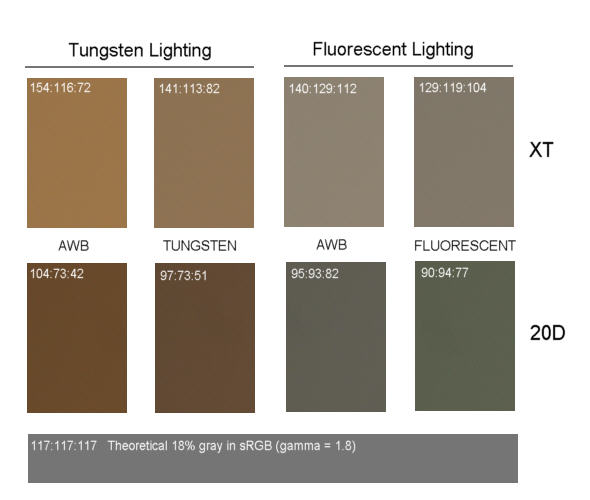
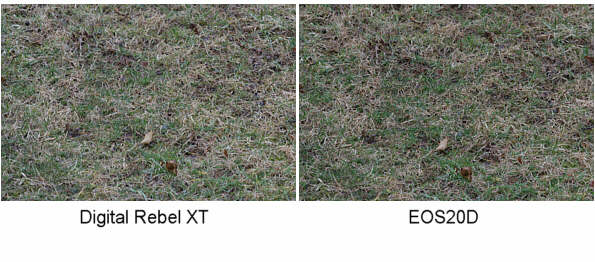
The images below show the same gray card shot under daylight illumination from a cloudy sky. 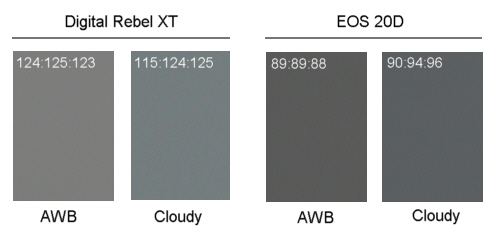 Note that in all cases and under any given lighting, if you use the custom white balance function you will get a neutral color balance, by definition. You shoot a gray (or white) card under the desired lighting and use that as a reference. This results in similar shots of the gray (or white) card being exactly neutral. The next two shots are the exact same scene shot with the Digital Rebel XT and the EOS 20D so you can see what a somewhat neglected lawn looks like in the rain! White balance was set to auto.
Both look better with slight level and color tweaks though, as shown below: 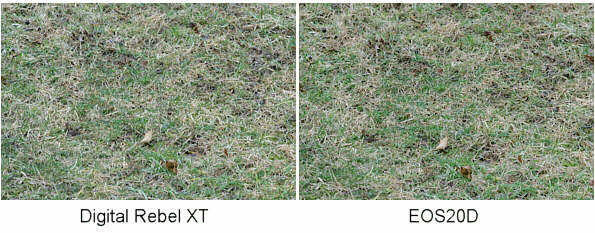 In these and other "real world" exposure tests I saw the 20D give, on average, about 1/3 stop less exposure than the Digital Rebel XT. This is with both cameras using exactly the same lens at the same aperture and the same parameter sets and other settings, and it was independent of metering mode (evaluative, partial etc.). This appears to be due to metering differences, not ISO differences, since at a given aperture the 20D seems to select a shutter speed about 1/3 stop slower. Whether you regard this as a defect or a feature could, I guess, depend on your point of view. The 20D images are a little darker - on the other hand they give you 1/3 stop more "headroom" for highlights under default conditions. Whether this difference is intrinsic to the camera metering algorithms and was designed that way by Canon or simply represents sample to sample variation in these two particular cameras, I don't know since I only have one sample of each to test. Infrared CapabilityWhile no DSLR is specified for IR use, many people are using them for IR work. Sensitivity isn't high and exposures are long, but I have seen some pretty good examples shot with cameras like the 20D and Digital Rebel.Below is a comparison of shots taken with the EOS 20D and Digital Rebel XT using a Hoya R72 filter. This blocks most visible light and allows most IR over 720nm to pass. There wasn't a lot of IR around for these shots. Conditions were overcast. 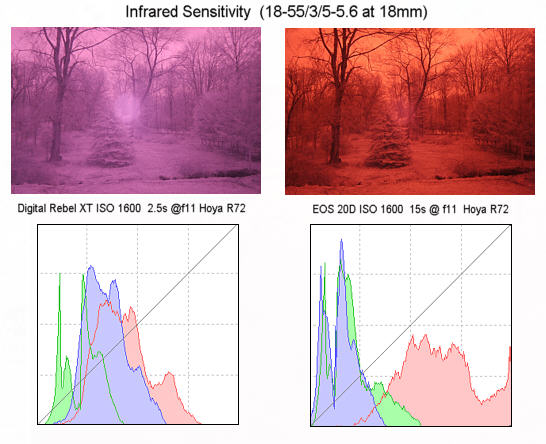
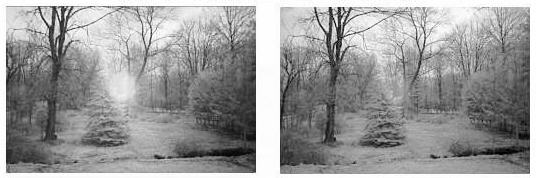
Of course IR images are usually converted into black and white (as shown above), and with enough manipulation both image can be made to look similar, though the XT's image needs stronger corrections Note the central "hotspot" in the XT's image. This is a phenomenon which has been observed with many DLSRs and which depends on the lens in use. Some "hotspot" much more than others. It appears to be due to some sort of back reflection from the surface of the sensor or sensor filters interacting with the lens. Whatever the cause, it seems to be significantly worse for the XT than for the 20D. So from these tests it seems that though the sensitivity of the XT to IR is higher (and exposure times therefore shorter), the intrinsic image quality (contrast) is lower and the hotspot sensitivity is higher. Further Reading
ConclusionThe Digital Rebel XT is a very capable camera indeed. The image quality equals that of the EOS 20D. It does have a few less bells and whistles than the 20D, but you save a signifcant amount of money and many photographers may not need the added features of the 20D. The XT has pretty much everything the average amateur photographer could want and I can certainly recommend it to the photographer on a budget. I think the EOS 20D is a better camera, but currently (03/06) it sells for about $400 more then the Digital Rebel XTIf you don't have another wideangle lens (like a 16-35 or 17-40), then get the XT with the EF-S 18-55 kit lens. It's inexpensive and it's not too bad. A better lens is the EF-S 17-85/3.5-5.6 IS USM. In fact for many photographers that may be the only lens they need. It's not cheap, but it covers a lot of popular focal lengths (equal to 28-135mm on a full frame camera) and it has Image Stabilization as well.
[Visit the HOME PAGE to see what else is new on the site]
© Copyright Bob Atkins All Rights Reserved |
|||
|
|